2nd Nov 2026
Updated on: 2nd Nov 2026
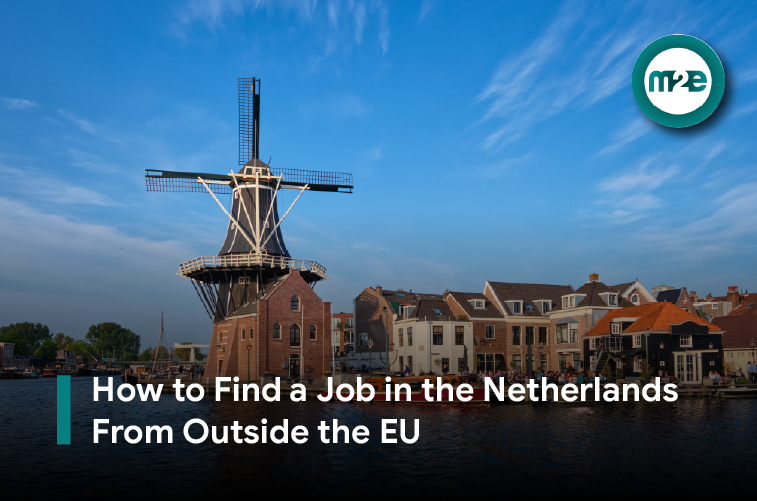
How to Find a Job in the Netherlands From Outside the EU
If you live outside the EU and want to find a job in the Netherlands, you need two things to line up: a real job offer, and an employer who is willing and allowed to support your residence and work permit. For most people from outside the EU, your nationality, qualifications, and salary decide which permit route is open to you, and the employer usually starts the application. That means a good job search does not begin with a long list of vacancies. It begins with knowing which route fits you, getting your documents ready, and focusing on employers who can actually hire you. You also need to check that every employer and agency you deal with is genuine. This guide covers each step: preparing your qualifications, searching through official channels such as EURES and the UWV public employment service, checking employers in the KVK business register and the IND public register of recognised sponsors, spotting scams and illegal fees, and understanding the permit routes behind a job offer.
What it takes to find a job in the Netherlands from outside the EU
EU, EEA and Swiss citizens can work in the Netherlands freely. They only need to register with the municipality where they live. Everyone else (third-country nationals) generally needs a residence permit that allows work, a separate work permit held by the employer, or a residence document that says no work permit is required. The Netherlands Labour Authority puts the main legal duty on employers: anyone who lets a foreign worker work without the required permit risks a fine under the Foreign Nationals Employment Act (Wet arbeid vreemdelingen, Wav). In practice, Dutch employers ask early in the process whether you already have the right to work. If you do not, they decide whether you are worth the time and cost of a permit application.
That decision comes down to a few questions an employer will ask, openly or not:
- Does the candidate meet the conditions of a permit route we can use, such as the highly skilled migrant scheme or the EU Blue Card?
- Are we a recognised sponsor with the Immigration and Naturalisation Service (IND), or would we need to become one?
- Does the salary we plan to offer meet the relevant threshold, and is it in line with the market?
- For roles outside the knowledge migrant schemes, can we show that no suitable candidate is available in the Netherlands or elsewhere in the EU or EEA?
Answer these questions in your CV, application letter,r and first interview, and you become a much easier hire.
Why the work permit route shapes your job search in the Netherlands
The Netherlands has several work permit routes, and each one points to a different kind of employer. The IND's overview of employing a foreign national sorts them into three groups. Knowledge and talent routes include the highly skilled migrant, EU Blue Card, researcher and intra-corporate transferee permits. Paid employment routes include the single permit. Other routes cover trainees, seasonal workers and cross-border service providers. For the full procedure, documents, fees and decision periods, see our separate guide on applying for a work permit in the Netherlands.
Highly skilled migrant Netherlands (kennismigrant)
The highly skilled migrant scheme is the most widely used work route for professionals. You cannot apply for it yourself. The IND states that only an employer recognised by the IND as a sponsor (erkend referent) can apply for your permit. You need an employment contract with that recognised sponsor or a research institution. Your salary must meet the income requirement and be in line with the market rate, which means comparable to the average pay for the same job. Healthcare jobs may also require registration in the BIG register.
The salary thresholds are gross monthly amounts. The IND does not count holiday allowance towards them. There are separate levels for applicants under 30, for applicants aged 30 or over, and a reduced criterion for recent graduates. The IND changes the amounts every year on 1 January. The amount that applies is the one in force on the date of application. Always check the current figures on the IND page on required amounts and income requirements rather than relying on a number you saw elsewhere. For your job search, the practical point is simple: if an offer is below the threshold for your age and situation, this route will not work, however keen the employer is.
EU Blue Card Netherlands
The EU Blue Card is the second main route for highly qualified workers. According to the IND, you need an employment contract of at least 6 months. You also need a higher education diploma from a programme of at least 3 years that is relevant to the job, or at least 5 years of relevant work experience at that level. For IT managers and IT professionals, the alternative is at least 3 years of relevant experience within the 7 years before the application. The Blue Card has its own salary threshold, published on the same IND income requirements page. Unlike the highly skilled migrant scheme, the employer does not need to be a recognised sponsor, and the IND provides a form so that the employee can apply too. If you hold a foreign diploma, Nuffic must evaluate it. So start the diploma evaluation early if you are aiming for this route.
Single permit GVVA and the labour market test
The single permit (gecombineerde vergunning voor verblijf en arbeid, GVVA) combines residence and work permission in one application to the IND. It is the standard route for regular paid jobs that do not fall under the knowledge migrant schemes. The big hurdle is the labour market test. Business.gov.nl explains that the employer must show that no suitable candidate is available within the EU or EEA, usually by registering the vacancy with UWV. On the single permit (GVVA) page, the IND lists among the conditions that the employer has first looked for an employee in the Netherlands and the EU or EEA, and that the salary is normal under the applicable collective labour agreement. The IND decides on the application and asks UWV for advice on the labour market aspect.
For job seekers, this has a clear consequence. In roles where many workers in the Netherlands or elsewhere in Europe could do the job, an employer is unlikely to pass the labour market test. Your chances are better in occupations where employers can show recruitment in Europe has failed. Labour shortages alone do not make you eligible, though. Our separate guide on labour shortages in the Netherlands looks at which sectors report the most unfilled vacancies.
Separate work permit TWV for short or special cases
The separate work permit (tewerkstellingsvergunning, TWV) is issued by UWV to the employer. UWV describes it as the permit for people who already have a residence permit without free access to work (for example, le some international students), for work shorter than 3 months, or for longer work where the person will not officially live in the Netherlands. Business.gov.nl says plainly that the employee cannot apply for a TWV themselves, and that UWV usually decides within 5 weeks of receiving the application. Seasonal work in agriculture and horticulture has its own rules. These are covered in our separate guide on seasonal work in the Netherlands.
Graduates and the orientation year
If you have recently completed a course, a PhD, or a research project, the orientation year residence permit for highly educated persons may be relevant. Netherlands Worldwide describes it as a route for people who want to find work in the Netherlands after completing their studies. You may be able to apply for the entry visa and the residence permit at the same time at a Dutch embassy or consulate. The IND sets the eligibility conditions, so check them there. The orientation year also matters for salary. The IND applies the reduced highly skilled migrant salary criterion when a highly skilled migrant application follows an orientation year, or falls within 3 years of graduation, promotion,n or the end of a research permit. This route is only open to people who meet its education conditions. It is not a general job seeker visa.
Prepare your qualifications before you apply.
Dutch employers who recruit from abroad want to understand your qualifications quickly. Getting them in order before you send applications saves weeks later.
IDW credential evaluation of a foreign diploma
International Credential Evaluation (IDW) is the official service for comparing foreign diplomas with the Dutch education system. On its page for working with a foreign diploma, IDW explains that a credential evaluation is advice showing which Dutch education level your diploma corresponds to. You cannot derive legal rights from it. Employers may ask for one, but it is usually not mandatory for unregulated jobs. The process runs online:
- Create an account in the My IDW portal and submit an application, uploading the documents required for your diploma. Originals are usually not needed unless IDW asks for them.
- Pay the fee when the payment link arrives by email. Each application covers one diploma. The fee is per diploma and is shown on the IDW site.
- Follow progress in your account. IDW will email you if documents are missing.
- Download the evaluation when it is ready. It stays available in your account for 3 years.
Nuffic also publishes descriptions of more than 100 foreign education systems. If your diploma appears there and your employer accepts that, a separate evaluation may not be needed. For the EU Blue Card, though, the IND requires an evaluation of a foreign diploma. Start it as soon as you are seriously applying, not after you receive an offer. IDW warns that missing documents and enquiries with other countries can slow things down.
Check whether your profession is regulated.
Some professions are regulated in the Netherlands. You cannot practise them until a competent authority has recognised your qualifications. Nuffic's guidance on working in the Netherlands with a foreign diploma says to check the European Commission's regulated professions database first. If your profession is listed, you must request permission to work and apply for professional recognition. IDW adds that people in regulated professions, such as medical and teaching professions, should contact the competent authority first rather than applying for a general evaluation. Health professions registered under the BIG system are the best-known example. The language and registration rules for these jobs are covered in our separate guide on Dutch language requirements at work.
A doctor, nurse or teacher who applies before starting recognition is usually turned down, because the employer cannot use them in the role. Applying while recognition is underway, and saying so, is more credible.
Prepare a Dutch-style CV and application letter.
EURES, the European job mobility network, publishes practical guidance on applying for jobs in the Netherlands. For qualified and highly qualified jobs, an application letter with a CV is the standard. A CV should normally be no more than two A4 pages. References and certificates do not need to be attached. Motivation is one of the most important selection criteria for Dutch employers, so your letter should explain why you want this role at this organisation. Do not just list your skills. EURES also notes that the Europass CV is not widely established among Dutch employers. For unsolicited applications, it recommends a standard Dutch style CV.
For an applicant from outside the EU, a few additions make a real difference:
- State your nationality and current country of residence clearly, so the employer can see at once that a permit is needed.
- If you meet the conditions of a specific route, such as the Blue Card education or experience criteria, say so briefly.
- Mention any diploma evaluation or professional recognition you have, or that is in progress.
- Give your notice period and a realistic availability date, allowing for permit processing.
- Be honest about your Dutch language level. Overstating it will come out at the interview.
Language at work
Dutch is the official language, and English is widely used in many workplaces, especially in international firms, technology, and research. Still, EURES advises that application letters are better received in Dutch unless the vacancy says otherwise. It also notes that the UWV job site is most useful if you can read Dutch. Basic Dutch widens the jobs open to you, and for long stays civic integration (inburgering) may become relevant, as our separate guide on the Dutch language explains.
Where to search for jobs in the Netherlands
A focused search through official and verifiable channels is safer and usually more effective than replying to every advert you see on social media.
EURES and the UWV public employment service (werk.nl)
EURES runs a European job portal and CV database, and its country page on living and working conditions in the Netherlands sets out how the Dutch labour market recruits. EURES describes CV databases, including those of EURES and UWV, as the norm. It also points to werk.nl, the UWV job site, as an option for people who read Dutch. Registration with UWV is not compulsory. UWV, recruitment agencies, universities and EURES also run job fairs and online recruitment events, including the European Job Days. These events are a chance to meet employers directly.
Keep in mind that EURES is built mainly for mobility within the EU and EEA. A vacancy on a European portal does not mean the employer will sponsor someone from outside the EU. Read each vacancy for clues: some say explicitly that they can support visa or permit applications, others that applicants must already have the right to work in the Netherlands.
Use the recognised sponsor register as a target list.
The IND publishes a public register of recognised sponsors for work. It is an alphabetical list of organisations recognised as sponsors for labour and highly skilled migrant purposes, each with its KVK number. The IND updates it once a month. If you qualify for the highly skilled migrant route, this register is effectively your target list. An employer that does not appear on it cannot currently file a highly skilled migrant application for you. It would first have to apply for recognition, which takes time and has conditions. Use it both to find organisations in your field that already know the sponsorship process and to check an employer after an offer.
Unsolicited applications and networks
EURES reports that a large share of vacancies in the Netherlands is filled informally and that unsolicited applications are very common. It suggests using the Chambers of Commerce register, embassies and company websites to research employers. For someone abroad, a well-aimed unsolicited application to an organisation that is already a recognised sponsor and active in your field can work better than general job board applications. Professional networks and alumni groups also count, and EURES warns that employers may look at your social media.
Recruitment and temporary work agencies
Recruitment and temporary work agencies are a major part of the Dutch labour market, especially in logistics, production and some technical roles. Agencies often start with an assessment or test, according to EURES. If you are approached by an agency or apply through one, find out early who your actual employer will be, who will apply for your permit, and whether your work will be supplied to another company. Agency work raises specific questions about registration, pay and fees, covered below.
How to check a Dutch employer before you accept an offer
Checking an employer takes a few minutes and is one of the most effective ways to protect yourself. Do it before you sign anything, pay anything, ng or resign from your current job.
Check the KVK business register.
Businesses operating in the Netherlands are generally required to register with the Netherlands Chamber of Commerce (KVK). KVK's guide on how to spot a fraudulent company says that if you cannot find a company on the KVK website, that is a serious warning sign. You can search by company name or KVK number. A registered entry shows the official trade name, KVK number, legal form, main activities, and visiting address. For details, such as contact details and the names of the people in charge, you can order a business extract for a small fee. KVK lists other warning signs too:
- A KVK number that belongs to a different company or a different line of business.
- A holding company presenting itself as the operating business.
- A registered address that turns out to be a family home in a residential area, where an office or site would be expected.
- Impressive job titles and paperwork covered in stamps, seals and official-looking signatures.
- Requests for payment by bank transfer, wire transfer or cryptocurrency.
Compare the KVK details with the employer named in your contract and in any permit paperwork. If the names, numbers or addresses do not match, ask why before going further.
Check the IND public register of recognised sponsors.
If an employer says it will sponsor you as a highly skilled migrant, look up its name and KVK number in the IND public register. The IND explains that recognised sponsors get faster procedures but take on duties around record keeping, providing information and duty of care. The IND checks sponsors through random checks, desk investigations, reports and company visits, working with the Netherlands Labour Authority. Breaches can lead to a warning, a fine, suspension or withdrawal of recognition, and that can affect the residence permits of the workers concerned. So an employer's good standing matters to you as well as to them. For the GVVA and the Blue Card, recognition is not required. In those cases, the KVK check and the employer's track record matter all the more.
Agency registration and the new authorisation scheme
Under the Placement of Personnel by Intermediaries Act (Wet allocatie arbeidskrachten door intermediairs, Waadi), any business that supplies workers to other companies must be registered in the KVK business register as a supplier of temporary staff. Business.gov.nl explains this Waadi registration and Waadi check. Suppliers that are not registered, or registered incorrectly, can be fined. So can the companies that hire workers from them. As a job seeker, you can use the same KVK check to confirm that an agency is registered as a supplier of staff.
A stricter system is on the way. Parliament has adopted the Act on the Admission to Supply Workers (Wet toelating terbeschikkingstelling van arbeidskrachten, Wtta). It introduces mandatory authorisation for temporary work agencies and other labour suppliers. According to Business.gov.nl, the conditions for authorisation include paying correct wages, filing taxes properly, holding a certificate of conduct, paying a deposit,t and offering approved housing to foreign staff. Suppliers without authorisation will not be allowed to supply workers, and companies that hire from them can be fined. The government has set an entry into force date and transitional rules for suppliers already operating. Enforcement by the Netherlands Labour Authority is planned to start one year after the act takes effect. Until the authorisation scheme applies, Waadi registration is the legal test. The Business.gov.nl page on authorisation of labour suppliers gives the current dates and position. Once the scheme is in force, ask any agency for proof of its authorisation.
Job scams and illegal fees to watch for
People who live far away, and who urgently need a sponsor, are an easy target for fraud. Most scams follow a few recognisable patterns.
Fees for finding you a job
Dutch law is clear here. The Waadi states that no payment may be required from the job seeker for job placement (arbeidsbemiddeling). It also bans charging the worker for being supplied to a company as agency or payroll staff. The full text of the Placement of Personnel by Intermediaries Act is on the official legislation portal. If an intermediary asks you for a registration fee, placement fee, or similar payment to get you a job in the Netherlands, treat it as a serious red flag. Get any request in writing and check it against the law before paying anything. Official charges are different: government fees, such as IND fees for a permit application or IDW fees for a diploma evaluation, are paid to the authority itself, and you can check them on that authority's own website.
The Waadi also gives agency workers, other than those in payroll arrangements, the right to at least the same terms on pay and allowances as employees in equal or equivalent jobs at the company where they work. A collective labour agreement may set this differently. Large, unexplained deductions from gross pay for housing, transport or administration are worth questioning. Our separate guide for employers hiring foreign workers in the Netherlands covers the employer's duties on minimum wage and payroll tax.
Other warning signs
- A job offer without any interview, or after a short chat on a messaging app, especially for a well-paid professional role.
- An employer you cannot find in the KVK register, or a claimed recognised sponsor that is not on the IND register.
- Pressure to pay quickly for a visa, permit,t or ticket to a private account. Real IND and embassy procedures have official payment channels.
- A promise of a guaranteed work permit. No employer or agency can guarantee an IND or UWV decision.
- Advice to travel on a short-stay visa and sort out the permit later. A short stay does not by itself give you the right to work, and working without the required permit has consequences for both you and the employer.
- A contract naming a different company from the recruiter, or without clear gross pay, hours and workplace.
Where to report abuse
The IND accepts reports of fraud through its fraud and abuse reporting page, including fake employment contracts, false documents, labour exploitation, human trafficking and information about sponsors. Private individuals can report anonymously. The IND refers unsafe or exploitative working conditions to the Netherlands Labour Authority, and crimes against you to the police. If the people involved are abroad, contact the authorities of the country concerned.
From job offer to work permit in outline
Once you have a genuine offer, the employer and the route decide the next steps. In outline:
- Agree the route. Confirm in writing with the employer whether they will apply for a highly skilled migrant permit, an EU Blue Card, a single permit (GVVA) or a separate work permit (TWV), and who submits the application.
- Check the salary against the route. Compare the gross monthly salary in the offer, excluding holiday allowance, with the threshold on the IND income requirements page for your age and situation, and ask how the employer assessed whether it is in line with the market.
- Prepare documents. Usually a valid passport, diplomas and any evaluation, and evidence of professional recognition for regulated jobs. Many nationalities also need a provisional residence permit (machtiging tot voorlopig verblijf, MVV) for stays over 90 days. The MVV and residence permit are applied for together in the entry and residence procedure.
- Wait for the decision before travelling to work. After a positive decision, you collect the MVV where needed and travel to the Netherlands.
- Register after arrival. You register with the municipality and get a citizen service number (BSN), which you need for payroll, health insurance and access to government services through DigiD.
Each step has its own rules, fees and timelines. These are in our separate guide on applying for a work permit in the Netherlands. If your job situation changes later, see our separate guides on changing employers and on job loss while on a Dutch work permit.
Policy changes to watch
Dutch labour migration rules are under active review, and job seekers should tell enacted rules apart from announced plans. The government has announced plans to tighten the highly skilled migrant scheme. These include raising the salary criterion, especially for applicants under 30, and stricter conditions for recognised sponsors, such as refusing recognition after repeated fines and withdrawing it from companies that have not employed a highly skilled migrant for two years or more. The announcement described these as measures still being worked out, not rules in force. The IND has also said that it is examining whether additional rules are needed for agency and payroll arrangements with highly skilled migrants.
Some changes are already in effect. Since the recast EU Single Permit Directive was implemented, the IND applies a longer job search period in some job loss cases for single permit and highly skilled migrant holders who have held their permit for a minimum period. The new authorisation scheme for labour suppliers is set to replace registration alone as the test for agencies. Before you act, check the IND, UWV and Business.gov.nl pages for the rules that apply on the date of your application, not what applied when an article or forum post was written.
Practical checklist for job seekers from outside the EU
- Identify the permit route you are most likely to qualify for, and check its conditions on the IND site.
- Compare your expected salary with the current IND threshold for that route, as a gross monthly amount excluding holiday allowance.
- Check whether your profession is regulated and, if so, start recognition with the competent authority.
- Arrange an IDW credential evaluation if needed.
- Search through EURES, werk.nl and the websites of employers in the IND public register of recognised sponsors.
- Check every employer in the KVK business register, and every agency for registration as a supplier of staff, and for authorisation once that scheme applies.
- Refuse to pay any fee for job placement, and report fraud or exploitation to the IND or the Netherlands Labour Authority.
- Get the offer, salary,ry and permit responsibilities in writing before resigning from your current job or booking travel.
No channel guarantees an offer or a permit, but targeting eligible employers, preparing qualifications early and checking every party avoids the most costly mistakes.
Sources and References
- Employing a foreign national, Immigration and Naturalisation Service (IND)
- Residence permit for highly skilled migrants, IND
- European Blue Card residence permit, IND
- Single permit (GVVA), IND
- Required amounts and income requirements, IND
- Public register of recognised sponsors for work, IND
- National highly skilled migrant scheme, IND
- Report fraud or abuse, IND
- Work permits for employers, UWV
- Permits and procedures when hiring foreign employees, Business.gov.nl
- How to apply for a work permit, Business.gov.nl
- Waadi registration and Waadi check, Business.gov.nl
- Suppliers of personnel must be authorised, Business.gov.nl
- Placement of Personnel by Intermediaries Act (Waadi), official legislation portal
- Foreign workers and the Foreign Nationals Employment Act, Netherlands Labour Authority
- MVV and residence permit for an orientation year, Netherlands Worldwide
- Credential evaluation to work, IDW
- Working in the Netherlands with a foreign diploma, Nuffic
- How to spot a fraudulent company, Netherlands Chamber of Commerce (KVK)
- Living and working conditions in the Netherlands, EURES
- Government plans to tighten the highly skilled migrant scheme, Government of the Netherlands
Get Started with M2S Group
How Can We Help You?
Choose the service that matches your needs.
-
Employers
Find qualified workers for your business.
Hire Workers -
Job Seekers
Explore job opportunities across Europe.
Find a Job -
Recruitment Partners
Build a trusted recruitment partnership with us.
Become a Partner
Ready to Start Your Journey to Europe?
Explore work, study, migration, and visa opportunities with Moving2Europe.eu.
Explore Your OptionsDisclaimer
This article is general information, not legal or immigration advice. Rules in the Netherlands differ by nationality, permit and occupation and can change. Confirm your situation with the competent Dutch authority, such as the Immigration and Naturalisation Service (IND), the Employee Insurance Agency (UWV) or the RDW.