2nd Nov 2026
Updated on: 2nd Nov 2026
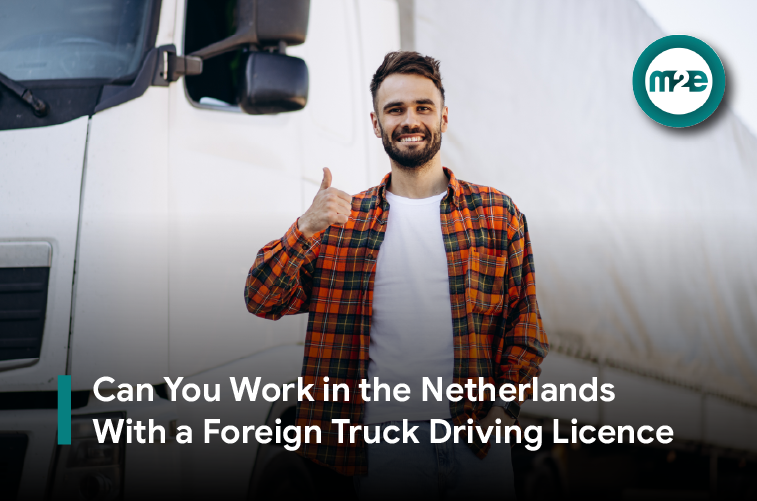
Can You Work in the Netherlands With a Foreign Truck Driving Licence
Yes, you can work in the Netherlands with a foreign truck driving licence, but usually only for a limited time and only if three separate conditions are met: the licence itself must be valid for driving in the Netherlands, you must hold a code 95 professional qualification that the Netherlands recognises, and you must have the right to work. A truck licence from another EU or EEA country or Switzerland with code 95 meets the licence and qualification conditions straight away. A foreign truck driving licence from outside the EU is a different matter: it can be used for only 185 days after you settle in the Netherlands, very few countries can exchange truck categories for a Dutch licence, and code 95 obtained outside the EU is not recognised. This guide explains each step, from the RDW licence exchange (rijbewijs omwisselen) to code 95, the driver attestation, and the work permit, so you can see what applies to you before you accept a job offer.
Three separate permissions for a foreign truck driver in the Netherlands
The Dutch system checks three different things, handled by different authorities, and none replaces the others.
- The right to drive the vehicle. This is your licence for category C (rigid trucks) or CE (truck with trailer). The RDW, the Netherlands Vehicle Authority, decides whether a foreign licence can be exchanged. The CBR, the Dutch driving test authority, runs driving exams and medical fitness decisions.
- The right to drive professionally. This is the certificate of professional competence, shown as code 95 on the licence or on a qualification card. It is obtained through CBR exams and kept valid through periodic training.
- The right to work. This is an immigration and labour question. Citizens of the EU, EEA and Switzerland work freely. Most others need a work permit (TWV) from UWV or a single permit (GVVA) from the IND.
A valid licence gives no right to work, and a work permit does not make a licence valid.
How long a foreign truck driving licence is valid in the Netherlands
The starting point is where your licence was issued and whether you now live in the Netherlands. The RDW sets out the limits on its page about driving with a foreign driving licence.
Licences from the EU, EEA and Switzerland
If you hold a licence issued in an EU or EFTA country and you live in the Netherlands, the rules differ by category. For cars and motorcycles, the RDW allows use for up to 15 years from the date of issue, subject to the licence's own validity. For the heavy categories, C1, C, C1E and CE (and the bus categories), the RDW states that you may continue to drive in the Netherlands for a maximum of five years from the date of issue of the licence, again subject to its validity. After that,t you need a Dutch driving licence. Holders of older EU licences should read the RDW page carefully, because a separate rule applies to licences issued more than 15 years ago.
An EU or EFTA licence can always be exchanged for a Dutch one if you are registered at a Dutch address, and the RDW states that an expired EU or EFTA licence can also be exchanged.
Licences from outside the EU
For a licence issued outside the EU and EFTA, the RDW states that you may use it for the first 185 days after you relocated to the Netherlands. After that period, od you may drive in the Netherlands only with a Dutch driving licence. This applies even if you have already applied for an exchange and are waiting for the result, so the RDW advises applying early. Processing takes at least 15 working days, and you will usually also need a CBR health declaration first.
Two further points matter for truck drivers. First, if the categories on your licence are not labelled with the European letters A, B, C, D and E, the RDW suggests also obtaining an international driving licence from the issuing country. Second, the Dutch government states that an international driving permit cannot itself be exchanged for a Dutch licence.
The 185-day period concerns the licence only. Even within it, you cannot drive a truck professionally without a recognised code 95 and the right to work.
Dutch driving licence exchange (rijbewijs omwisselen) for truck categories
Exchange means handing in your foreign licence and receiving a Dutch one with equivalent categories, without retaking the driving test. The RDW decides, but you apply through your municipality. The procedure is described on the RDW page on exchanging a foreign driving licence.
Who can apply
The RDW lists conditions that you must all meet:
- You are registered in the Personal Records Database (BRP) at your municipality.
- You have EU or EFTA nationality, or you hold a temporary or permanent Dutch residence permit, or you are in the Netherlands under Association Decision 1/80 (Turkish nationals), or you fall under the Temporary Protection Directive (residence permit 46).
- For a licence from outside the EU and EFTA, the licence must still be valid, and the issuing country must have an agreement with the Netherlands, unless the expat scheme applies.
The RDW states that exchange is not possible while you are waiting for a new residence permit.
Countries whose truck categories can be exchanged
This is where most drivers from outside the EU run into difficulty. The RDW list of agreements gives, for each country, the categories that can be exchanged. Only a short group of jurisdictions are listed for all categories, which would include trucks:
- Great Britain and Northern Ireland (all categories, with BE only if a separate exam was taken)
- Gibraltar, Guernsey, Jersey and the Isle of Man
- Monaco
- The former Netherlands Antilles (Aruba, Bonaire, Curaçao, Saba, Sint Eustatius and Sint Maarten)
Other countries on the list, such as Japan, South Korea, Israel, Singapore, Chinese Taipei, Andorra and the Canadian provinces of Alberta and Québec, are listed only for passenger car and,d in some cases, es motorcycle categories. Their truck categories are not listed for exchange. Countries that do not appear on the RDW list at all have no exchange agreement for any category.
The practical result is blunt. If your truck licence comes from a country outside the EU that is not listed for all categories, your category C or CE will not be converted, and you would need to pass the Dutch exams. Check the current RDW list before planning, because agreements can change.
One exception covers former Dutch licence holders: the RDW states that you may be able to exchange back and receive the categories you held on an earlier Dutch licence, subject to a cut-off date on the RDW page.
The 185-day rule in the issuing country
A second 185-day rule applies to the exchange itself. For a licence from outside the EU and EFTA, the RDW states that you must have lived in the issuing country for 185 days in the year you obtained the licence. If you passed your truck test during a short stay in that country, an exchange may therefore be refused even when the country is on the list. Keep evidence of your residence for that period.
The expat scheme route
The RDW also states that if you are in the Netherlands for work as a highly skilled migrant and the expat scheme applies (the tax facility often called the 30% ruling), you can exchange a licence from any country. You then need a valid decision on the expat scheme from the Tax and Customs Administration (Belastingdienst). The RDW page does not set out category limits for this route in its summary, so confirm with the RDW before relying on it for trucks.
Drivers from Ukraine under temporary protection have a separate rule. The RDW states that they may continue to drive in the Netherlands with their Ukrainian licence, even if it has expired, but can exchange it for a Dutch licence only with a 30% ruling from the Tax and Customs Administration.
Documents and procedure at the municipality
You apply at the municipality where you are registered. Only the municipality can submit the application to the RDW. The RDW asks you to bring:
- a recent colour passport photo meeting the Dutch photo requirements
- your foreign driving licence, with a translation by a certified translator, embassy or consulate if it uses characters not used in the Netherlands
- any old Dutch driving licence you hold
- the decision on the expat scheme from the Tax and Customs Administration, if you use that route
- a CBR health declaration, which the RDW requires for licences from outside the EU and EFTA and which may also be needed for some EU and EFTA licences
You fill in the application form and pay the fee at the municipality. The RDW states that the fee may vary per municipality, so ask your municipality for its current amount. The RDW then sends a letter within 15 working days. If everything is in order, you can collect your Dutch licence from the municipality after 5 working days. Missing information delays the decision.
Two consequences are easy to overlook. First, you will not get your foreign licence back. Second, an expired licence from outside the EU and EFTA cannot be exchanged, so start the process before it expires. During the exchange, the RDW advises against driving in other countries, and you must still respect the 185-day limit in the Netherlands.
Using a Dutch licence elsewhere in the EU
The European Commission's Your Europe portal warns that if you later move to another EU country with an EU licence that was issued in exchange for a licence from outside the EU, your licence may not be recognised there. Drivers planning to move on to another member state should check that country's rules on licence exchange and recognition.
Medical fitness for categories C and CE
Truck categories come with medical checks in the Netherlands. The Dutch government states that anyone applying for, renewing, or extending a large licence (C1, C1E, C and CE, and the bus categories) must always be medically examined.
The medical examination procedure for large licences works as follows:
- You complete the health declaration (gezondheidsverklaring) through the CBR. It asks about conditions that could affect driving, such as epilepsy, dizziness,s or high blood pressure.
- A company doctor or a certified occupational health service carries out the medical examination.
- The signed declaration and the medical report go to the CBR.
- A CBR medical adviser decides whether you are fit to drive a truck or bus. If you are, the CBR records a declaration of fitness, which the municipality and the RDW then use.
Start the health declaration as soon as you know you need it, particularly within the 185 days. The doctor's fee is separate from the municipal licence fee, so ask what it covers before the appointment.
When exchange is not possible
If your truck categories cannot be exchanged, the RDW and the Dutch government both state that you must take the theory and practical tests at the CBR to obtain a Dutch licence. For a truck driver from outside the EU, that typically means working through several steps:
- Category B first. Truck categories build on a car licence. If your car licence cannot be exchanged either, you would need to obtain a Dutch category B licence before the truck categories.
- Category C, then CE. Each has its own theory and practical exams at the CBR, plus the medical examination described above.
- Code 95 initial qualification. This is a separate set of professional exams, covered in the next section.
Lessons are usually given by private driving schools and training providers, which set their own fees, separate from the CBR exam fees. Ask in writing what a price covers, such as lessons, exam bookings, retakes, and vehicle hire. No provider can guarantee a pass or a job.
Code 95 in the Netherlands for professional truck drivers
Code 95 is the EU certificate of professional competence for truck and bus drivers. Business.gov.nl states plainly that professional truck and bus drivers need a certificate of professional competence (code 95) on their driving licence, and that under EU rules all professional truck and bus drivers must hold it. The full rules are on the Business.gov.nl page on code 95 for professional drivers.
Driving without code 95
Business.gov.nl states that without code 95 you may drive a truck or bus professionally for no more than 12 hours a week. This narrow allowance is no route to a full-time driving job. Some categories of drivers are exempt from code 95 entirely. The Human Environment and Transport Inspectorate (ILT) provides a guidance tool on exemptions; employers should check it before assuming an exemption applies.
Code 95 from the EU
If you hold a category C or D licence from another EU country with code 95, Business.gov.nl states that you may drive a truck or bus professionally in the Netherlands. You must keep your code 95 valid through periodic training. Business.gov.nl notes that refresher training must be completed in the country of residence or work, and drivers who live in the Netherlands and exchange their EU licence must follow the Dutch rules from then on.
Code 95 from outside the EU is not recognised.d
For drivers from outside the EU, the key line on Business.gov.nl is short: a code 95 or equivalent professional qualification obtained outside the EU is not recognised in the Netherlands, and you must follow the Dutch procedure to obtain code 95. Years of professional driving at home do not change this. The common rules come from the EU directive on the initial qualification and periodic training of drivers.
Initial qualification in the Netherlands
To obtain code 95 in the Netherlands, ds you take the initial qualification (basiskwalificatie) through the CBR, where the professional exams are run by the CBR's division for professional and vocational exams (CCV). Business.gov.nl lists these points:
- You need a valid category B licence.
- You must be at least 18. Minimum ages for driving the truck categories themselves depend on the qualification route, so check the CBR rules for your situation.
- You need a medical fitness certificate.
- You must pass all exams within a period of two years.
- After passing, you apply at your municipality to have code 95 added to the licence.
- Code 95 is then valid for five years.
The RDW explains on its page on the certificate of professional competence (Verklaring van Vakbekwaamheid) that the code is printed after the vehicle category on the licence and is valid for five years. Ask the CBR which exam languages are available before you book.
Periodic training every five years
To keep code 95, you must complete at least 35 hours of refresher training before it expires. Renewal extends the code by five years. The RDW explains two options once the training is done. You can renew your licence, which renews categories C and D at the same time and requires a valid CBR health declaration. Or you can replace your licence, which only adds the new code 95 end date without changing the expiry of your truck categories; replacement can be done only at the municipality and needs no health declaration.
The RDW also states that refresher training completed abroad cannot be converted into a code 95 on a Dutch licence. If you live in the Netherlands, plan your refresher training here.
The qualification card for drivers who do not live in the Netherlands
Some drivers work for a Dutch employer but are not registered at a Dutch address. For them, hem the RDW issues a qualification card (kwalificatiekaart), which serves as proof of refresher training. The RDW lists four conditions on its qualification card page:
- you have a Dutch employer
- you have a valid category C or D on your licence
- you are not registered at an address in the Netherlands (in the BRP)
- you completed your refresher training in the Netherlands
Drivers from Ukraine under the Temporary Protection Directive follow different conditions: they must be registered in the BRP. The RDW assesses applications within 10 working days, and you must collect the card at the chosen RDW location within three months. The RDW publishes the fee on the same page. Note that the qualification card records periodic training on an existing recognised qualification; it does not convert a qualification obtained outside the EU.
Driver attestation for drivers from outside the EU
International road haulage for hire or reward inside the EU runs on a Community licence held by the transport company. When that company employs a driver who is not an EU national, an extra document comes into play: the driver attestation (bestuurdersattest).
What the EU rules say
Under the EU regulation on access to the international road haulage market, the member state where a haulier is established issues a driver attestation to a haulier that holds a Community licence and lawfully employs, or lawfully uses, a driver who is neither an EU national nor a long-term resident. The driver must be employed under the employment and professional training conditions of that Member State. Key features are:
- one attestation is issued per driver, on request of the haulier
- the haulier holds it and makes it available to the driver when driving under the Community licence
- the haulier keeps a certified copy at its premises
- It must be presented to authorised inspectors on request
- The issuing Member State sets the validity, up to a maximum of five years
- It lapses if its conditions are no longer met, and the haulier must return it immediately
The EU driver qualification directive adds that a driver attestation can serve as proof of professional qualification for these drivers, provided the issuing member state has entered the Union code 95 in its remarks section. The code may be entered only if the driver has met the qualification and training requirements.
How it works in the Netherlands
Business.gov.nl states, on its page on road haulier licences, that drivers from outside the EU are only allowed to drive a Dutch haulier's trucks if they have a driver attestation, issued by the Dutch National and International Road Transport Organisation (NIWO). Its conditions include a valid work permit and a certificate of professional competence. The attestation sits on top of the work permit and code 95 and cannot replace them. Three practical points follow:
- The application is made by the haulier, not by you. You cannot obtain a Dutch driver attestation on your own.
- The attestation is tied to your employment with that haulier. If you change employers, the new employer would need its own attestation for you.
- The attestation belongs to the framework for commercial carriage under a Community licence. Business.gov.nl notes that companies transporting their own goods (own account transport) do not need a haulage permit, so whether an attestation applies depends on the type of work. Ask your employer which documents your job requires.
Work permit Netherlands for truck drivers
The licence and code 95 answer whether you may drive. They do not answer whether you may work. That depends on your nationality and residence status.
Citizens of the EU, EEA and Switzerland
The Dutch government states that Dutch, other EEA and Swiss nationals do not need a work permit. They need a valid passport or identity card, and if they settle in the Netherlands,s they register at the municipality, which gives them a citizen service number (BSN).
Drivers from outside the EU
Business.gov.nl states, on its page on work permits for employees, that nationals from outside the EU, EEA and Switzerland generally need a work permit. There are two types:
- Work permit (TWV), issued by UWV on the employer's application. Business.gov.nl lists it for employees already in the Netherlands with a residence permit, for work of no more than 90 days, or for work of more than 90 days without living in the Netherlands.
- Single permit (GVVA), a combined residence and work permit decided by the IND, for work of more than 90 days while living in the Netherlands. The employer or the employee can apply.
The labour market test
For both routes, the employer must show that it could not find a suitable candidate closer to home. The Dutch government's page on what permits foreign workers need states that the employer must make every effort to find staff in the Netherlands, another EEA country or Switzerland, and that the vacancy must be open for at least five weeks, or three months if UWV considers it difficult to fill. The IND page on the single permit adds that the employer must have registered the vacancy with UWV and must pay a normal salary under the applicable collective labour agreement. UWV also sets conditions on the employer, including compliance with Dutch employment law and no fines for violating it in the past five years.
A shortage of drivers does not remove the labour market test. Demand for drivers is a separate question from eligibility, which is covered in our separate guide on labour shortages in the Netherlands. If you change employer on a GVVA, the IND states that the new employer must apply for a new permit. Our separate guides on applying for a work permit and on changing employers explain the procedures.
Ukraine and other special cases
Business.gov.nl states that people from Ukraine covered by the Temporary Protection Directive can work without a TWV if the employer notifies UWV in advance. This does not apply to nationals of other countries who held a temporary residence permit for Ukraine.
Drivers employed by transport companies in other EU countries
Many drivers from outside the EU who drive on Dutch roads are not employed in the Netherlands at all. They work for hauliers established in other member states, who hold the work and residence permission and the driver attestation in that country. A Dutch parliamentary answer by the Minister of Social Affairs and Employment describes the posting of third country nationals as a legal route when they already have the right to work and reside in another member state, and repeats that a driver attestation may be issued only if the driver meets the conditions, including the mandatory code 95 training.
Whether Dutch pay rules apply to such a driver depends on the type of journey. A later parliamentary answer explains that under the EU rules on posting in road transport, a driver counts as posted to the Netherlands when carrying out cabotage (domestic transport inside the Netherlands by a foreign haulier) or cross trade, but not on a simple bilateral trip between the home country and the Netherlands. Where posting applies, Dutch minimum wage and the core terms of generally binding collective labour agreements apply. The ILT checks driving and rest time rules, and the Netherlands Labour Authority checks working conditions.
If a haulier in another EU country offers you work driving mainly in the Netherlands, ask which country issues your permit and attestation, which law governs your contract, and whether pay is stated gross or net. Your residence and work rights then come from that other countryStep-by-stepep plan for a driver from outside the E.U
Some documents depend on others, so the order matters. For a driver from outside the EU who wants to live in the Netherlands and work for a Dutch haulier, a realistic sequence is:
- Check your licence against the RDW list, including the 185-day residence rule for the year you obtained it.
- Agree the permit route with the employer. The employer runs the labour market test and applies for a TWV or supports a GVVA application. Do not travel on a promise alone.
- Arrive and register in the BRP, which the licence exchange requires.
- Start the CBR health declaration early.
- Exchange the licence or take the CBR exams for the categories you need.
- Obtain code 95 through the Dutch initial qualification.
- Let the employer apply for the driver attestation once your work permit and code 95 are in place, if your job requires one.
- Track expiry dates for the 185-day limit, your residence permit, your truck categories, and code 95.
Each authority decides independently, and no intermediary can promise an outcome from the RDW, CBR, UWV or IND.
Common mistakes and how to avoid them
Most problems for foreign truck drivers in the Netherlands come from timing and from documents that look official but are not.
- Driving after day 185. The limit applies even with an exchange application pending.
- Letting the foreign licence expire. An expired licence from outside the EU and EFTA cannot be exchanged, so apply well before the expiry date.
- Buying documents. Offers to sell a licence, code 95 or qualification card without exams are fraud. Genuine Dutch licences and code 95 entries come only through the RDW, the CBR and the municipality.
- Paying recruitment fees. Ask any intermediary what a fee covers and whether it is lawful to charge it to you. Our separate guide on finding a job in the Netherlands from outside the EU explains how to check employers and agencies.
- Confusing the international driving permit with a licence. It only translates your national licence and cannot be exchanged.
What to check before accepting a truck driving job in the Netherlands
Before you sign, ask the employer to confirm in writing who will apply for which permit, whether the job is for a Dutch haulier or a haulier in another EU country, whether the employer will support your code 95 initial qualification, and whether the contract states gross pay and the applicable collective labour agreement. You can check a Dutch company's registration in the Commercial Register at KVK.
For the licence itself, the RDW is the authority on exchange, the CBR on exams, code 9,5 and medical fitness, and your municipality is where you apply and collect. For permits, UWV and the IND decide. Rules can change, so confirm the current position with these bodies before acting on any offer.
Sources and References
- Exchanging a foreign driving licence, RDW
- Driving with a foreign driving licence, RDW
- Buitenlands rijbewijs omwisselen, RDW
- Rijden met een buitenlands rijbewijs, RDW
- Verklaring van Vakbekwaamheid (code 95), RDW
- Kwalificatiekaart, RDW
- Exchanging a foreign licence for a Dutch licence, Government of the Netherlands
- Medical examination for a large driving licence, Government of the Netherlands
- Code 95 for professional drivers, Business.gov.nl
- Applying for road haulier licences, Business.gov.nl
- Work permit for employees, Business.gov.nl
- What permits do foreign workers need, Government of the Netherlands
- Single permit (GVVA), IND
- Work permits for employers, UWV
- Regulation on access to the international road haulage market, EUR-Lex
- Directive on the qualification and training of professional drivers, EUR-Lex
- Driving licence exchange and recognition, Your Europe, European Union
- Parliamentary answer on drivers from third countries in Dutch road transport, House of Representatives
- Parliamentary answer on posting rules and enforcement in road transport, House of Representatives
Get Started with M2S Group
How Can We Help You?
Choose the service that matches your needs.
-
Employers
Find qualified workers for your business.
Hire Workers -
Job Seekers
Explore job opportunities across Europe.
Find a Job -
Recruitment Partners
Build a trusted recruitment partnership with us.
Become a Partner
Ready to Start Your Journey to Europe?
Explore work, study, migration, and visa opportunities with Moving2Europe.eu.
Explore Your OptionsDisclaimer
This article is general information about working in the Netherlands with a foreign truck driving licence and is not legal or immigration advice. Rules differ by nationality, permit, licence and occupation and can change. Confirm your situation with the competent Dutch authority, such as the RDW, the CBR, the Immigration and Naturalisation Service (IND) or the Employee Insurance Agency (UWV).